From private practice to public confidence
Building a digital safety net to help anxious speakers overcome hesitation and join the local community.
scope
- User Research
- Prototyping
- UI/UX Design
skills
- Branding
- Project Management
- Interaction Design
timeline
5 months
Project overview
I led the strategic design of the Speakers’ Café digital extension, a mobile application designed to bridge the gap between private rehearsal and physical community participation.
Speakers’ Café is a public speaking club based in Sheffield (UK) that helps individuals overcome ‘social anxiety’.
Despite a strong local reputation, the business faced a significant bottleneck:
"Potential members were often too intimidated to attend their first in-person session".
The challenge
The primary objective was to design a digital tool that serves as a supportive entry point into the club’s ecosystem.
We needed to provide a way for users to practice in total privacy while gradually building the confidence required to participate in a live, physical environment.
The challenge was to move beyond standard vocal coaching and address the root cause of the problem, which is the psychological fear of human judgment.
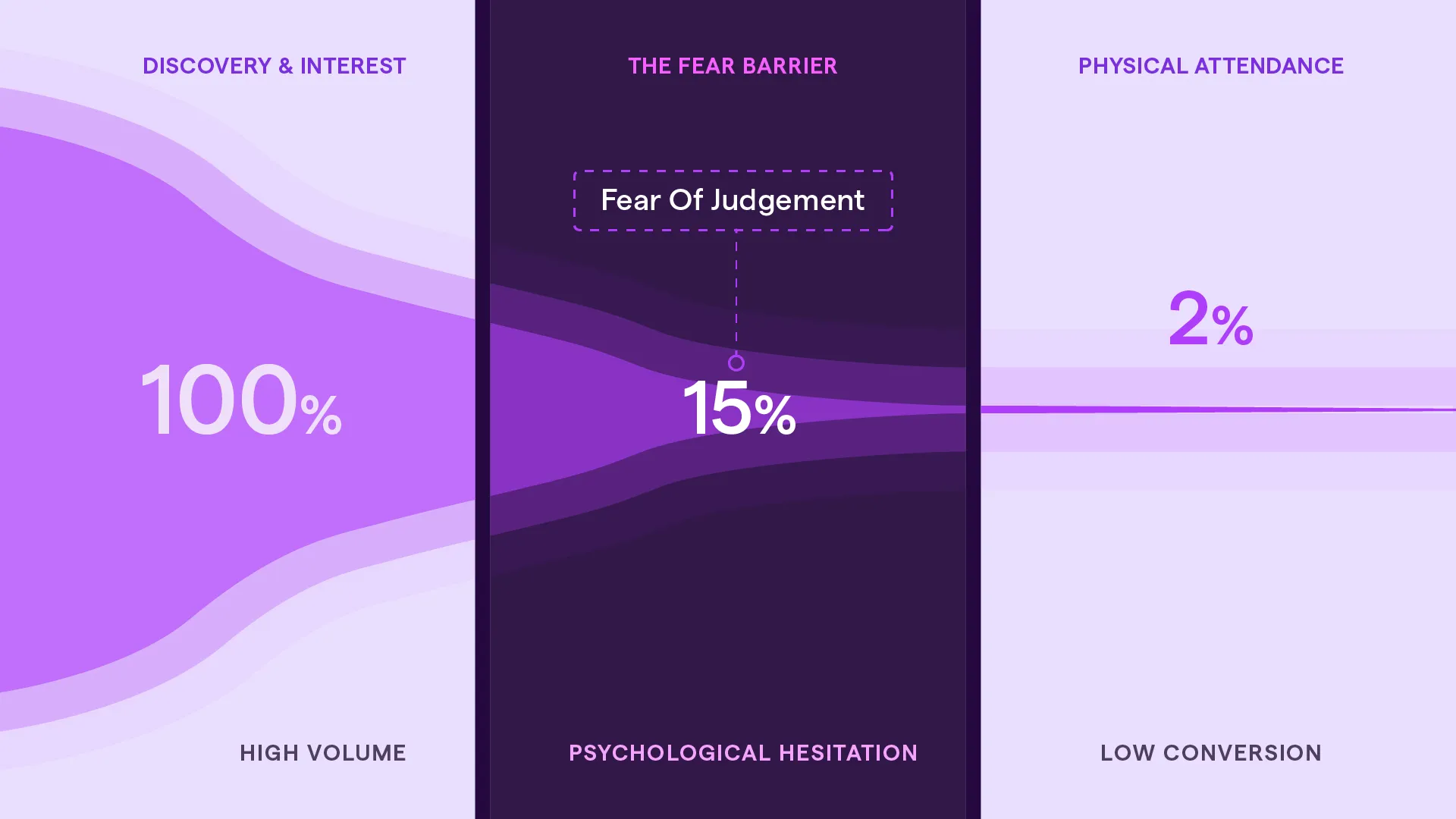
The Attendance Bottleneck
The solution
I developed the Digital Safety Net, a core design principle that prioritises emotional security over technical performance.
The final solution features a private, AI-supported rehearsal space and a unique Visibility Slider.
This component allows users to control their level of social exposure, moving at their own pace from solo practice to trusted peer feedback.
This gradual exposure model ensures that the transition from a digital screen to a physical room feels like a natural progression rather than a steep social risk.
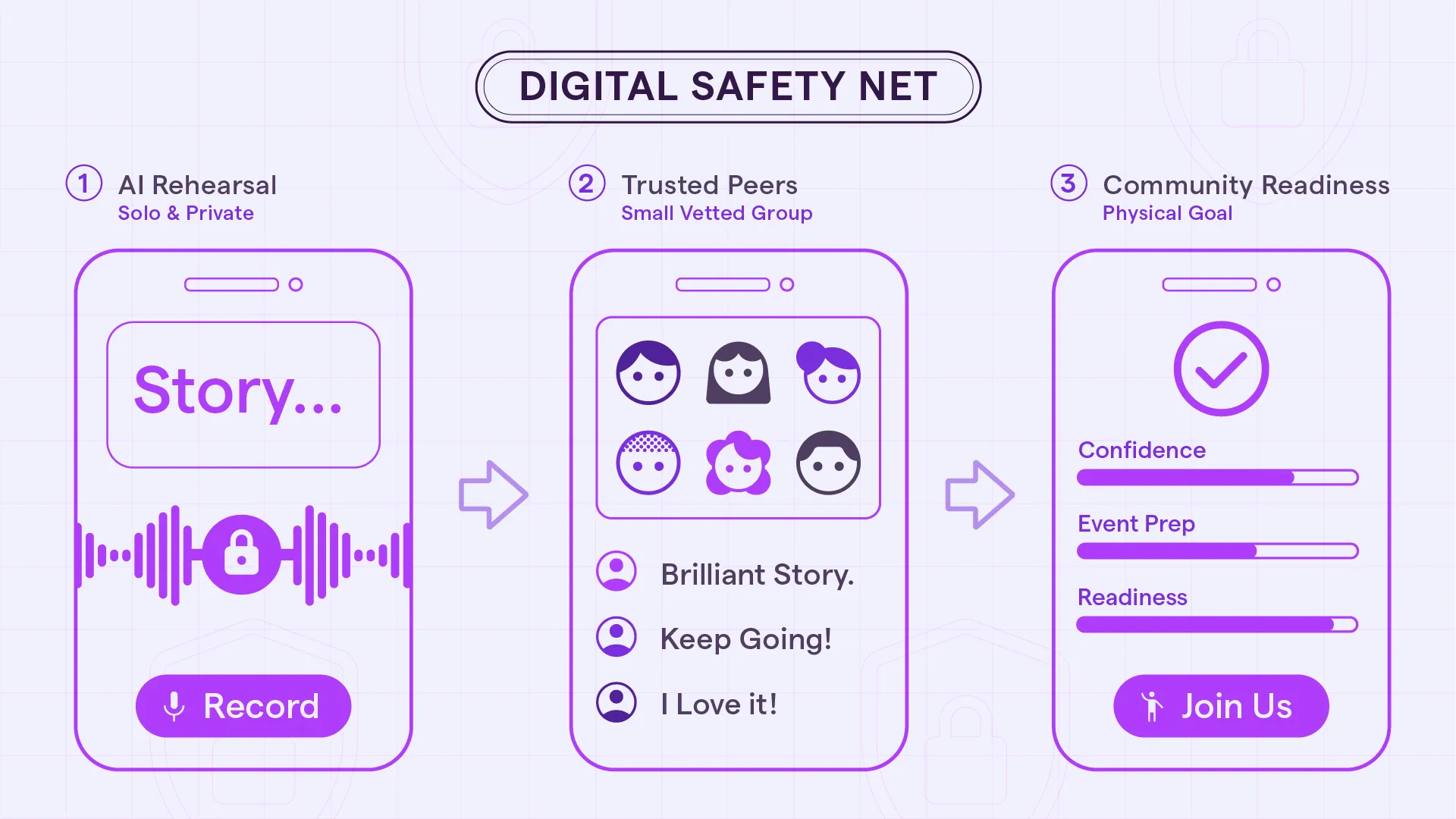
The Digital Safety Net Ecosystem
The outcome
-
System Usability Scale (SUS)
The prototype app achieved an average score of 97.5, placing it in the top percentile for user experience.
97.5 -
Conversion Readiness
100% of the study participants confirmed they were prepared to attend an in-person session in Sheffield after using the app.
100 -
User Confidence
We observed a consistent improvement in confidence scores; for instance, the highest-anxiety persona transitioned from a 1/5 (Hesitation) to a 3/5 (Managed Readiness) during a single session.
3/5
Business alignment
I worked closely with the founder Lee Furness, to developed a digital version of the Speakers’ Café model to increase attendance at 'Speak Up' sessions in Sheffield.
I focused the feature set on private rehearsal to lower the barrier to entry for anxious users.
By building this 'user readiness' through the app, we created a clear bridge to high-tier services like one-to-one coaching, successfully positioning the digital tool as a supportive entry point to the club’s physical community and premium services.
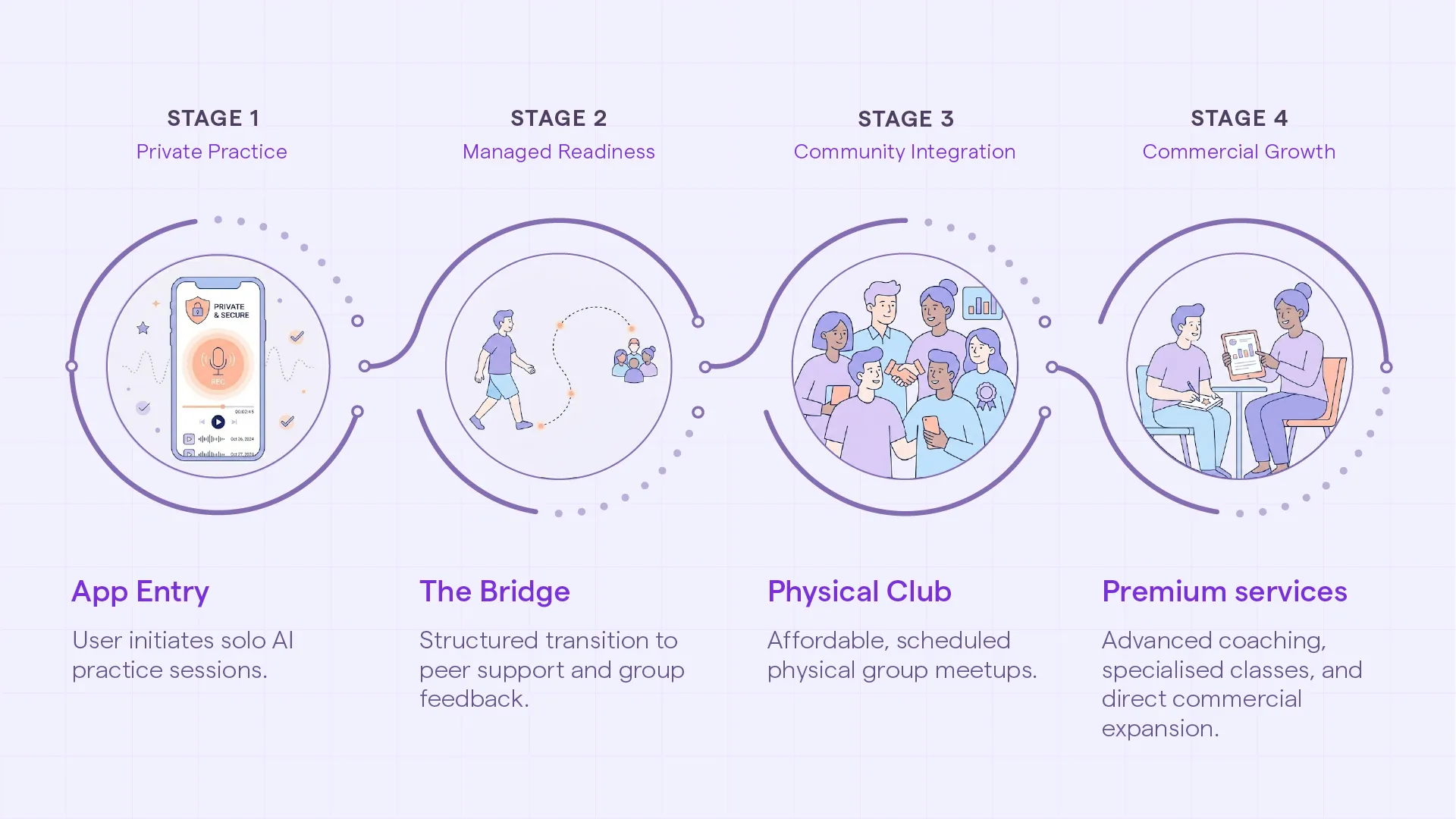
Business Service Alignment
Market Analysis
I conducted a competitive audit of leading speech coaching platforms, including Speeko, Orai, and Vocal Image.
The analysis revealed a consistent industry focus on vocal mechanics, such as tracking pitch, resonance, and filler word frequency through automated AI analysis.
While these tools provide high technical granularity, they operate as isolated user experiences and do not address the psychological barriers or social anxiety associated with public speaking.
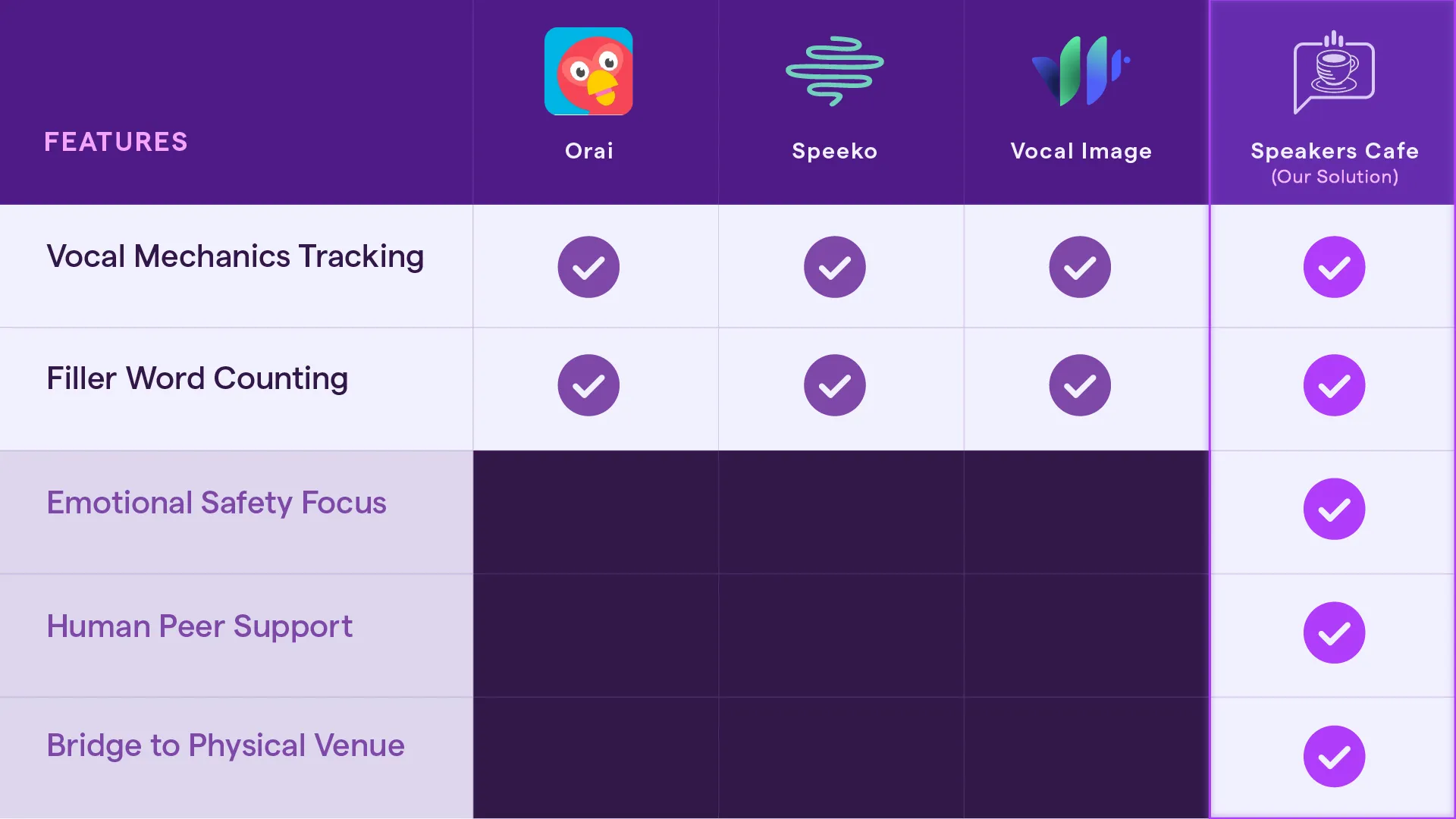
Competitive Landscape Audit
To address a clear market gap in emotional readiness and psychological safety, I developed a model that prioritises human nuance over automated feedback.
Unlike competitors that rely solely on AI, Speakers Café utilises an extensive peer network to provide the accuracy and empathy that algorithms lack.
This approach transforms the user experience into one of ‘mutual support’, building collective confidence through shared journeys.
Ultimately, this shifts the app’s positioning from a technical performance tracker to a community-focused psychological resource.
User Strategy
Through user research, I identified ten distinct personas spanning a spectrum of public speaking experience and confidence levels.
I selected 'Cautious Catherine', representing the beginner-to-intermediate user with high social anxiety, as the primary design driver.
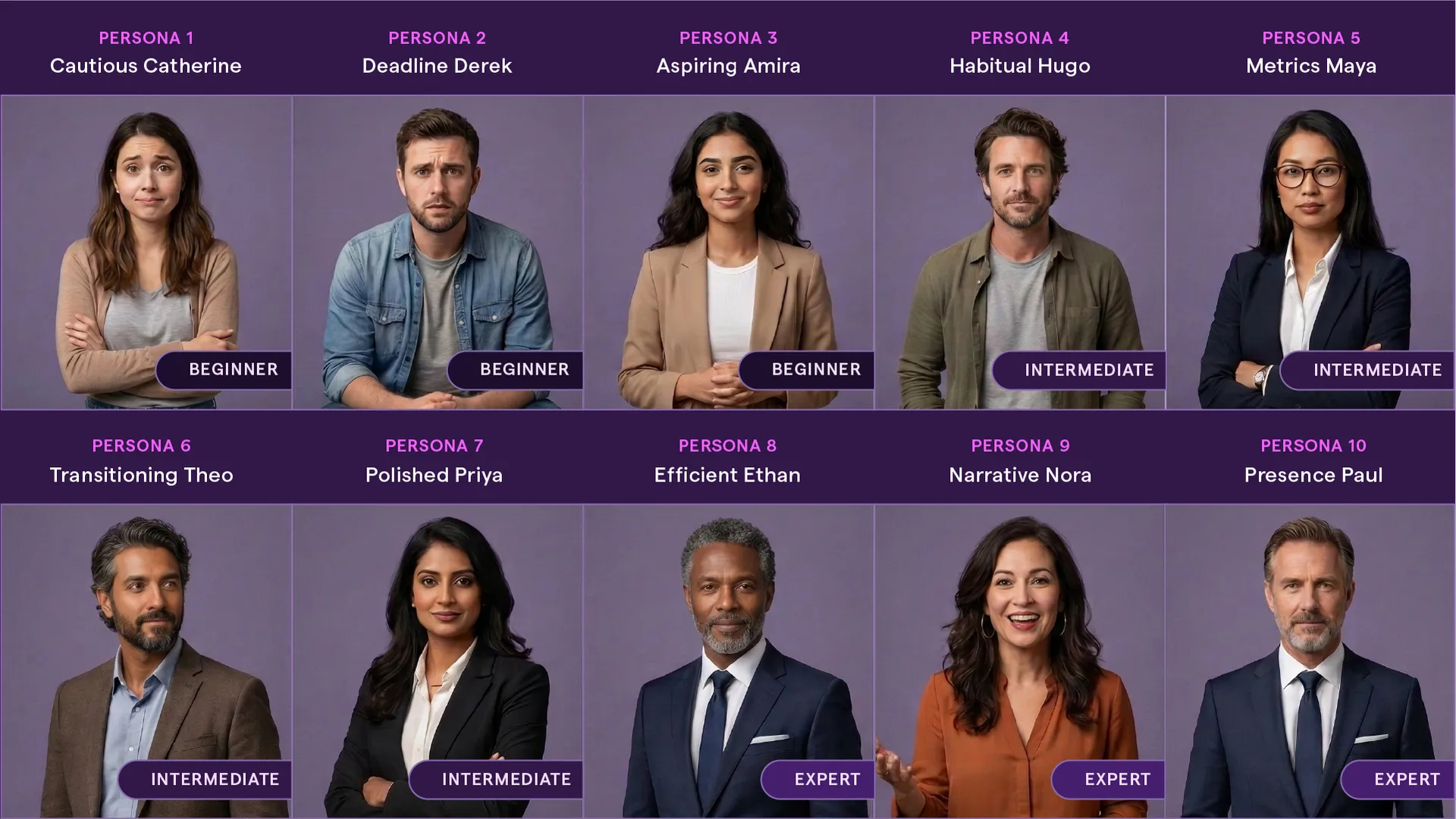
Ten Distinct personas
This choice informed an ‘inclusive design’ approach.
I determined that by solving for the specific friction points encountered by the most hesitant users, the resulting interface would be inherently accessible for more confident speakers.
Research indicated that Catherine viewed public speaking as a social threat rather than a skill to be mastered.
This insight shifted the project focus away from technical mastery and toward reducing the perceived risk of participation for the entire user spectrum.
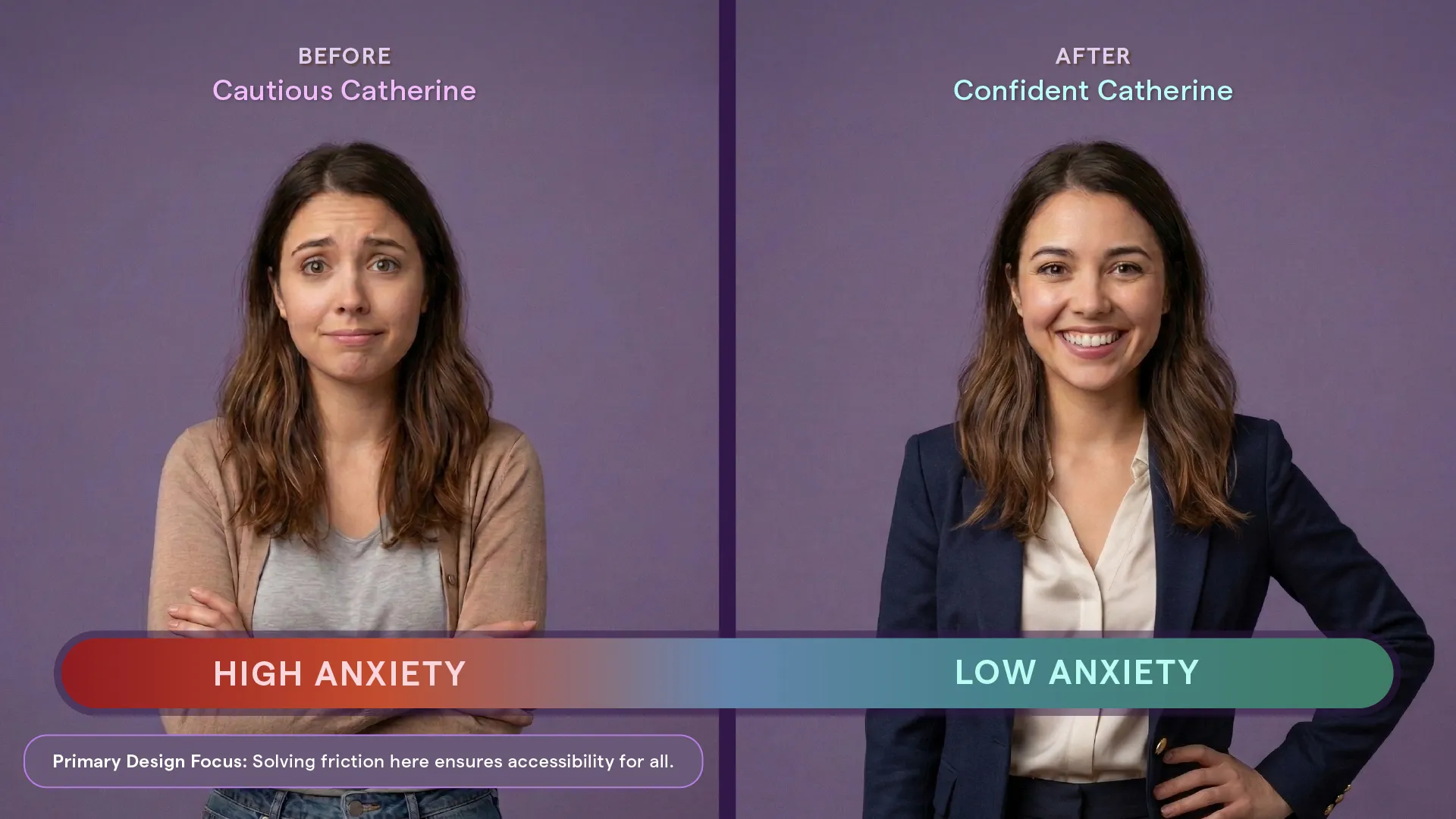
Persona Inclusivity Spectrum
Strategic Insights
The synthesis of research data resulted in the establishment of the 'Digital Safety Net' as the foundational design principle.
This term refers to a risk-mitigation strategy where the digital environment serves as a private, low-stakes rehearsal space.
The primary function of this safety net is to remove the fear of external judgment, which research identified as the primary barrier preventing users from attending in-person sessions.
Recognising that psychological readiness is the foundation of technical skill development, I prioritised user confidence over formal mechanics like vocal projection.
For high-anxiety beginners, traditional public speaking metrics can often act as barriers rather than aids.
To counter this, I implemented a reassurance model within the information architecture.
This approach ensured every digital touch-point reinforced a sense of security, effectively preparing users for the leap into the in-person community.
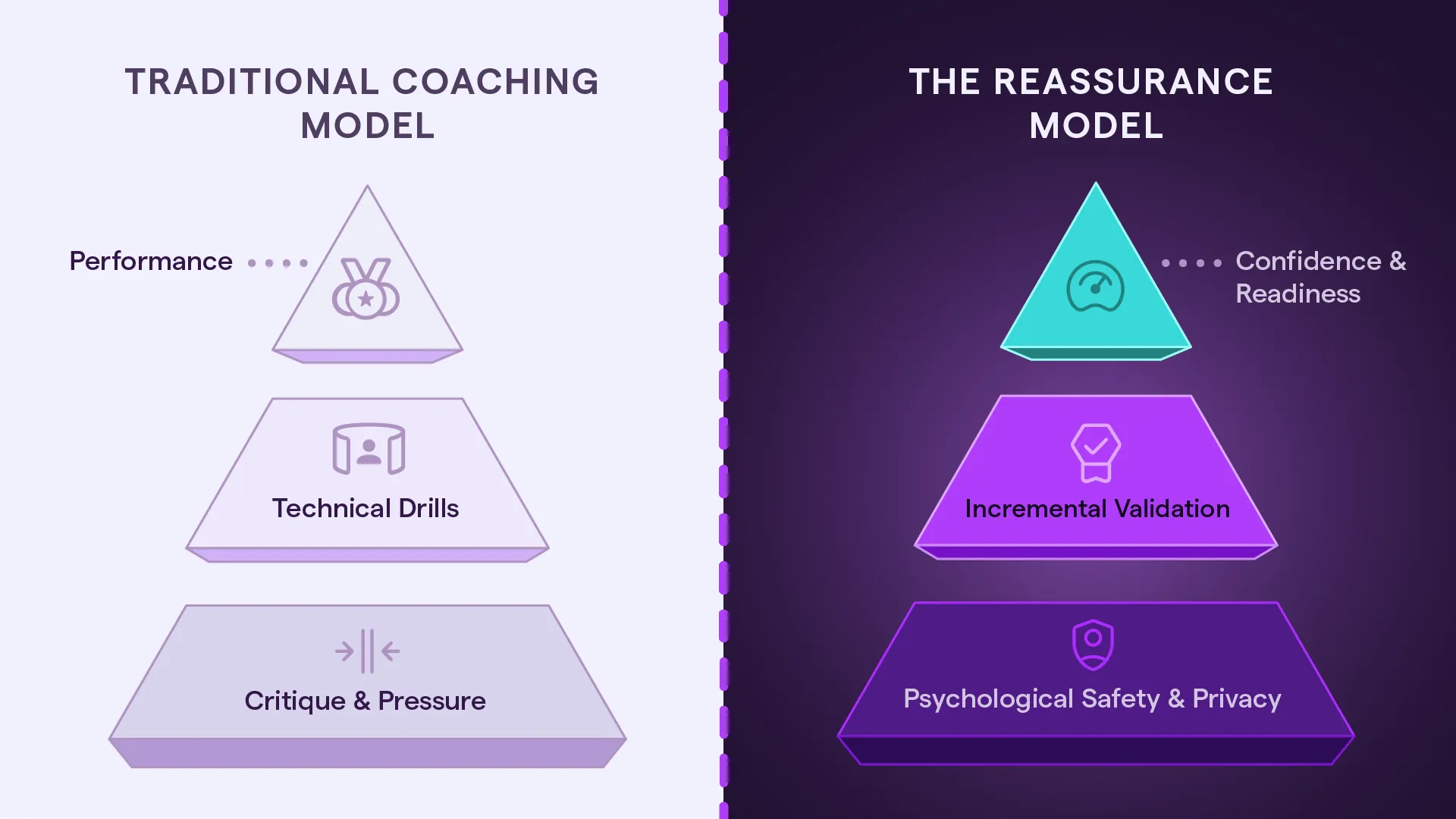
The Reassurance Information Architecture
Technical Approach
To manage resources and maintain project momentum, I selected Figma as the primary prototyping environment.
This choice was driven by the need for operational efficiency and a streamlined workflow. The integrated nature of Figma allowed me to design and build complex interactions within a single tool, avoiding the time-intensive process of exporting assets to more specialised platforms like ProtoPie.
While advanced tools offer higher fidelity, their steeper learning curve was not compatible with the lean requirements of this validation phase.
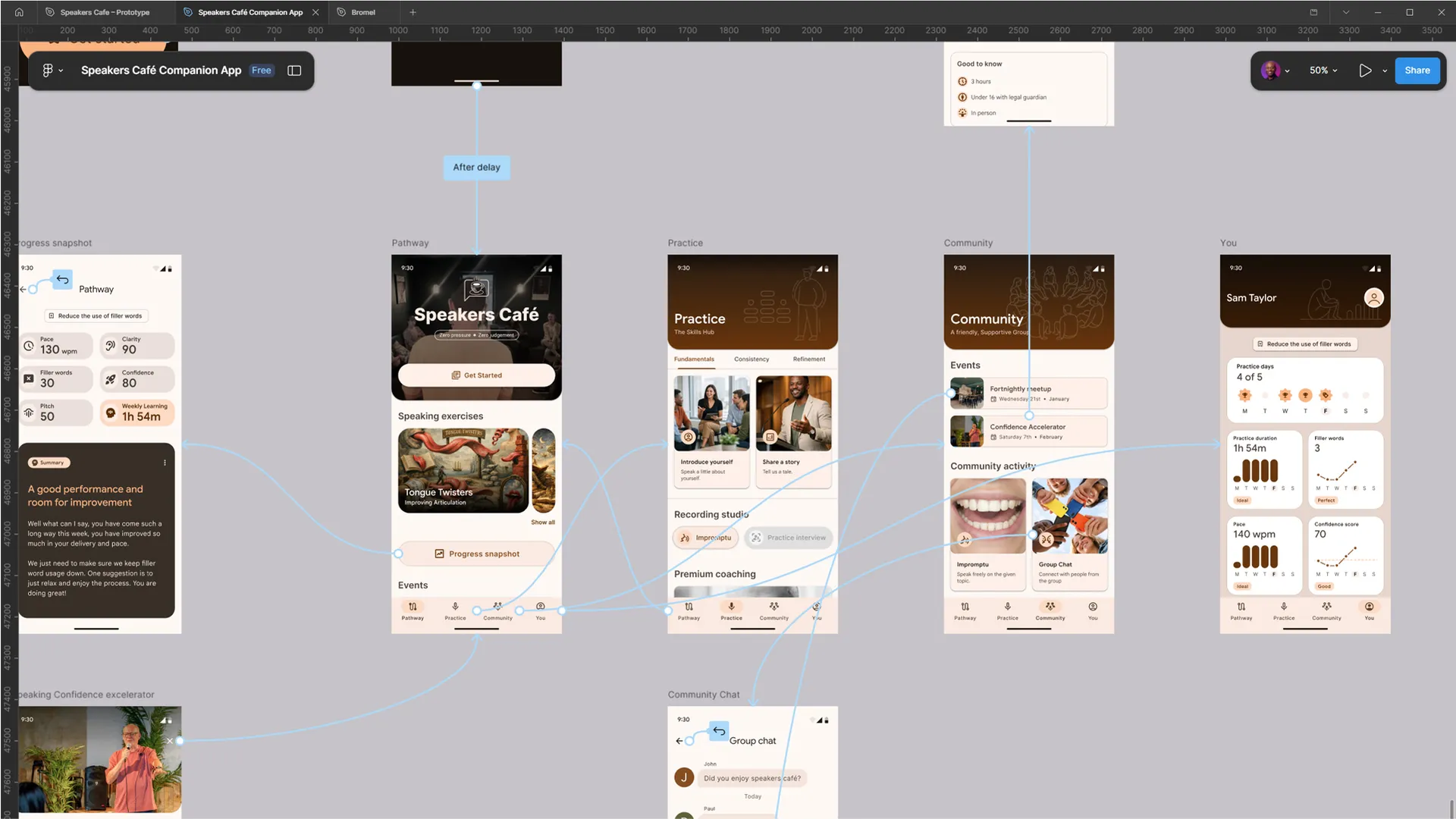
Figma Prototype Interaction Logic
By leveraging Figma’s advanced variables and conditional actions, I simulated a personalised feedback experience to test the 'Digital Safety Net' model.
This strategy allowed us to evaluate the product’s psychological impact and iterate quickly without the high costs of immediate AI integration.
This high-fidelity validation ensured that the service model was effective and fully refined before moving into the production-level engineering phase.
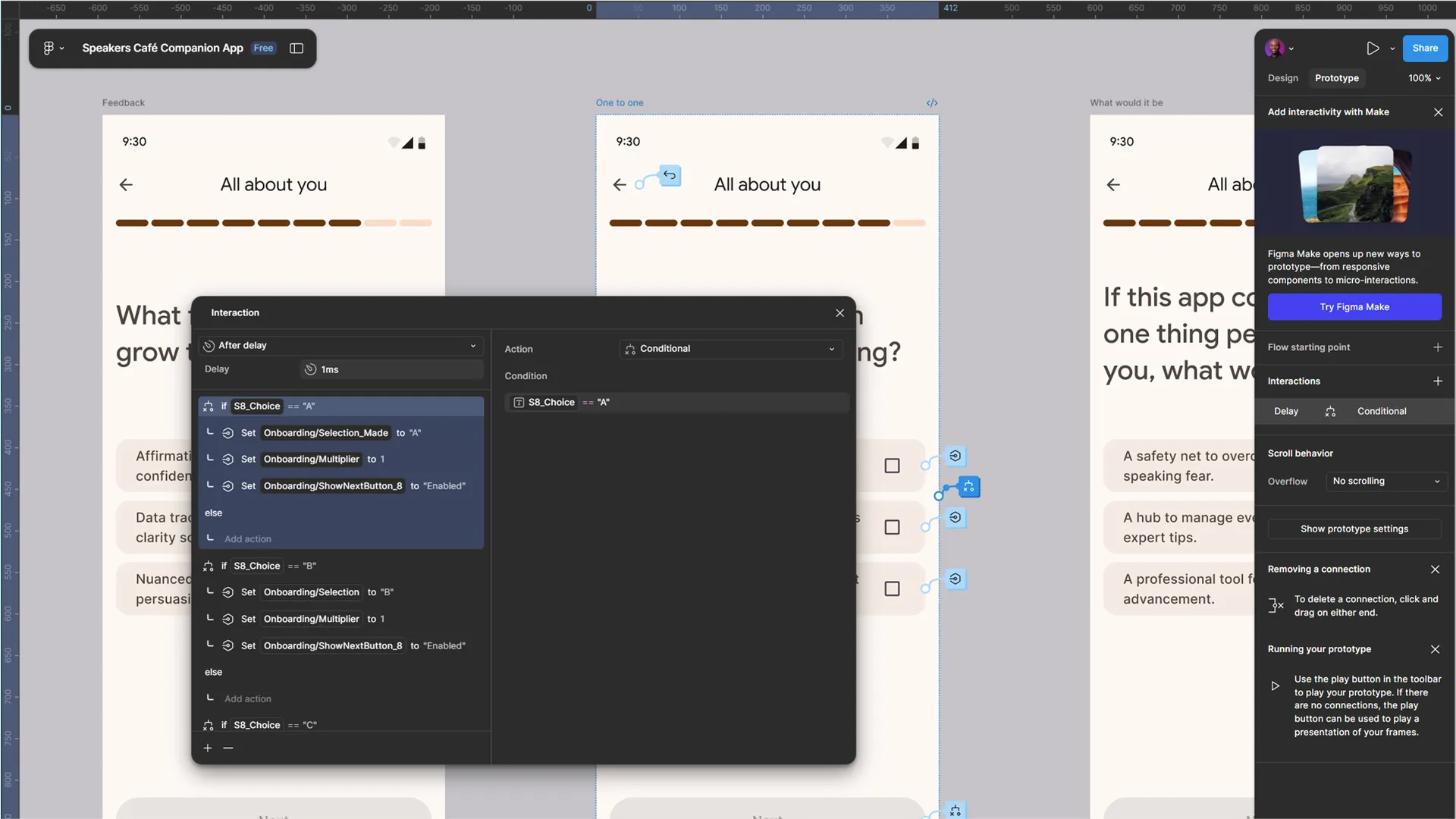
Complex Variable Mapping
Initial Hypothesis
The first version of the prototype used a simple button paired with clear privacy disclaimers.
I assumed that by being transparent about AI analysis and the private nature of the community, users would feel secure enough to share their progress.
The ‘initial hypothesis’ was that technical transparency alone would be enough to provide the necessary reassurance for users to move from private rehearsal to community validation.
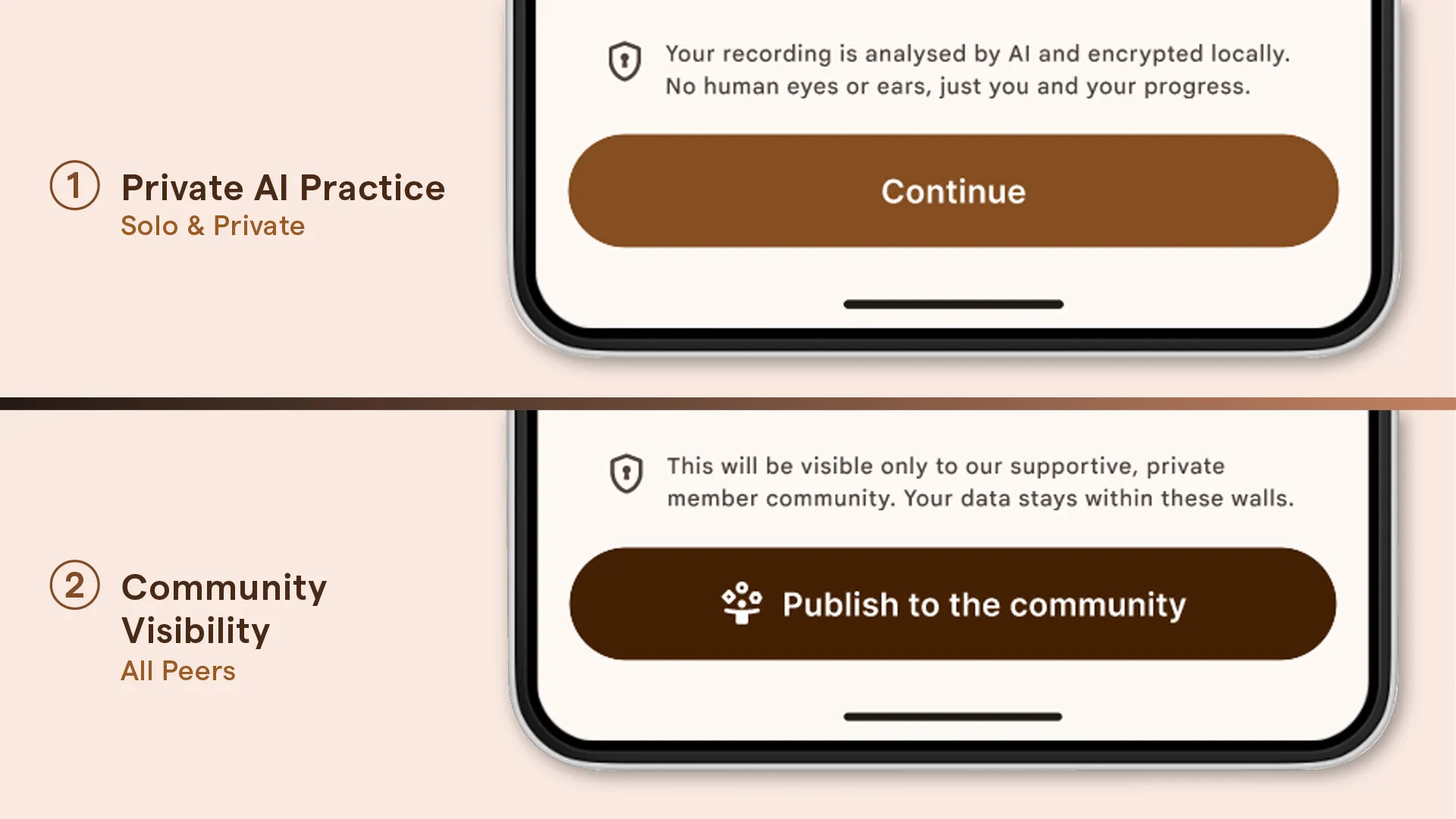
Baseline Decision Interface
Validation insights
Testing confirmed that while the interface was easy to use, it did not account for the emotional weight of the transition.
Even with clear disclaimers, the jump from "private AI practice" to "community visibility" was perceived as a significant social risk.
Participants described the choice as too absolute, leading to a noticeable spike in hesitation at the point of sharing.
This indicated that the psychological barrier remained high because there was no way to test the waters before going public.
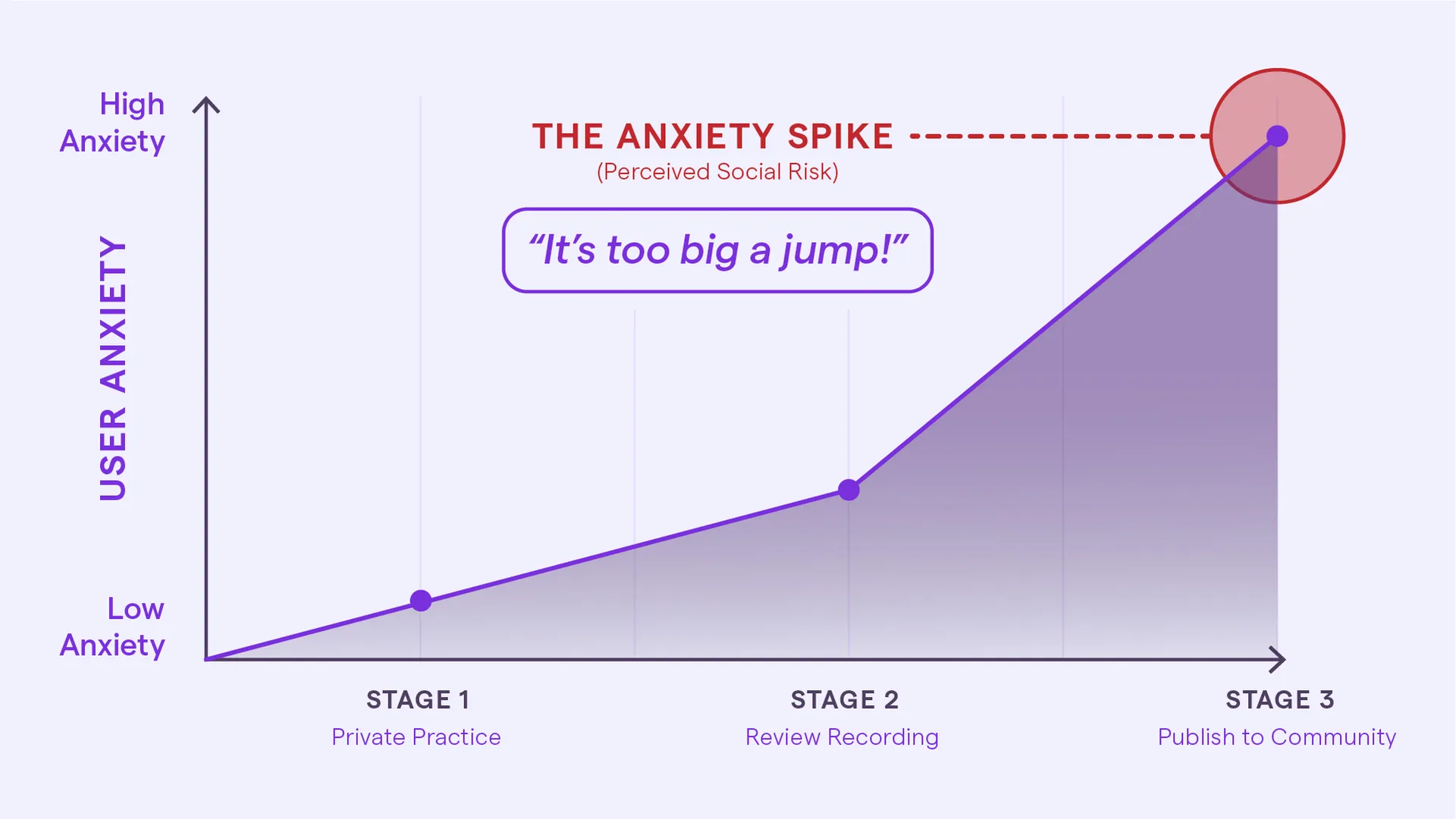
User Friction Mapping
The visibility slider
To bridge this gap, I introduced a multi-state Visibility Slider.
This component replaced the fixed button states and allowed users to choose their level of exposure: Private, Trusted Peers, or Full Community.
By adding a middle ground for feedback from a smaller, vetted group, I provided a safer path for users to build their confidence.
I maintained the use of the Shield Icon to visually reinforce that the user remained in total control of their privacy throughout the process.
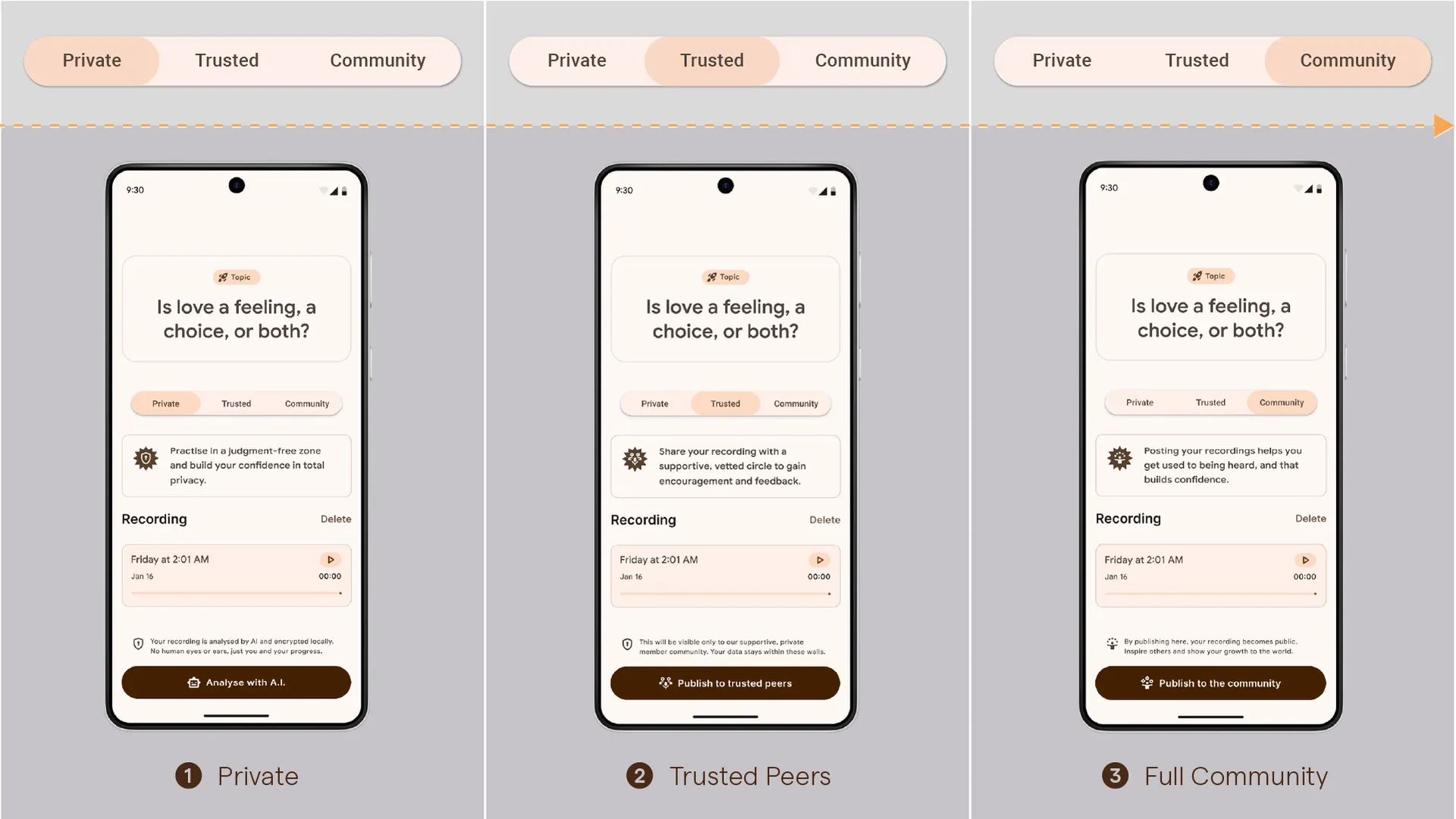
The Visibility Slider
Rationale and Impact
This pivot prioritised psychological safety over a simpler layout.
Providing a "highlight switch" for social presence allowed users to progress at their own pace rather than forcing an immediate decision between total privacy and public exposure.
This incremental approach was essential for long-term engagement. In final validation sessions, this modification removed the previous hesitation and resulted in a 100% success rate for the sharing task.
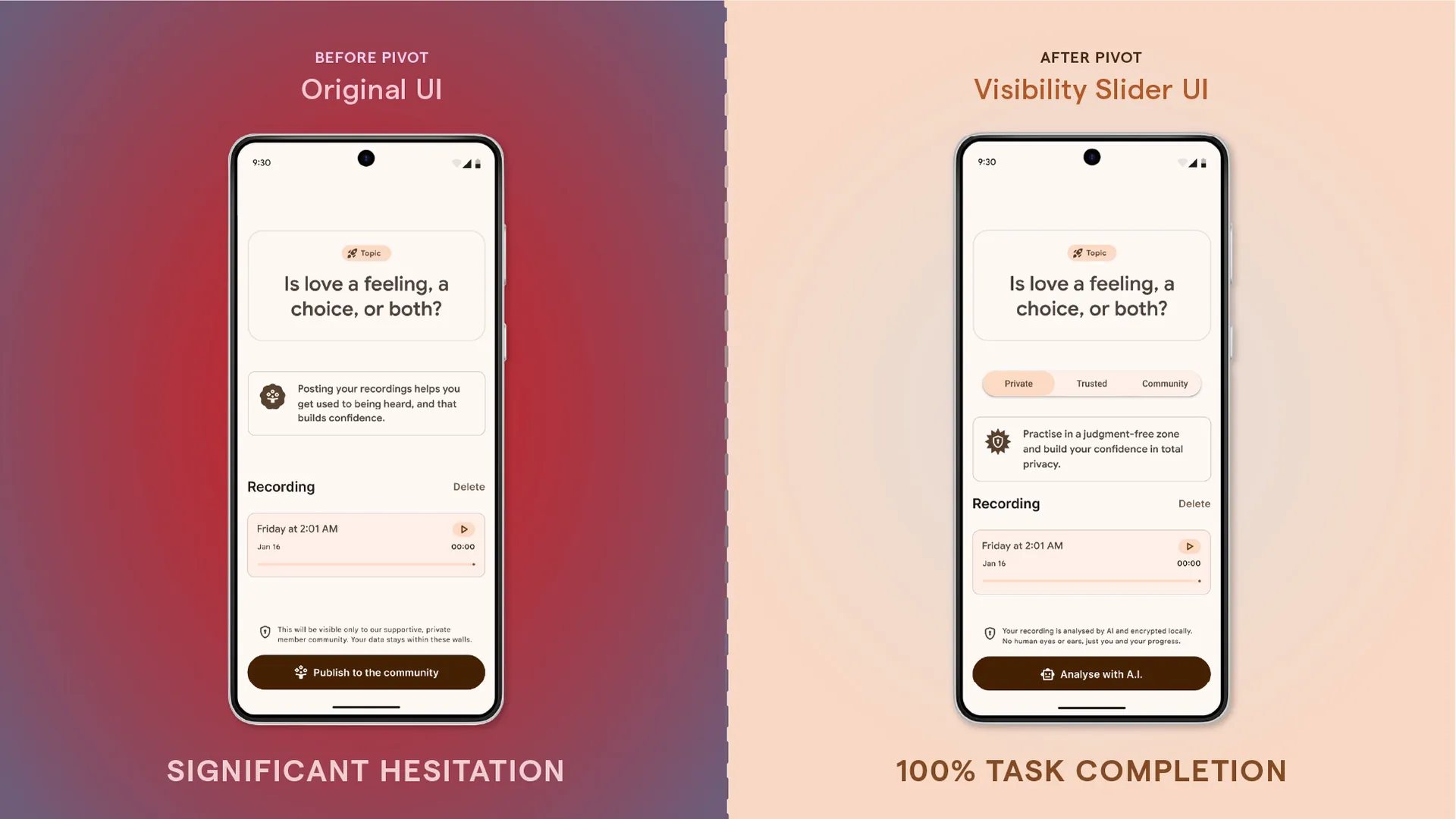
Behavioral Flow Comparison
Tailored Onboarding
The experience begins with a diagnostic assessment where users answer a series of targeted questions to identify their specific anxiety triggers and current speaking proficiency.
This data allows the system to customise the initial practice modules to the user's comfort level.
This structured entry point reduces the initial cognitive load and ensures the first interaction feels personal rather than generic.
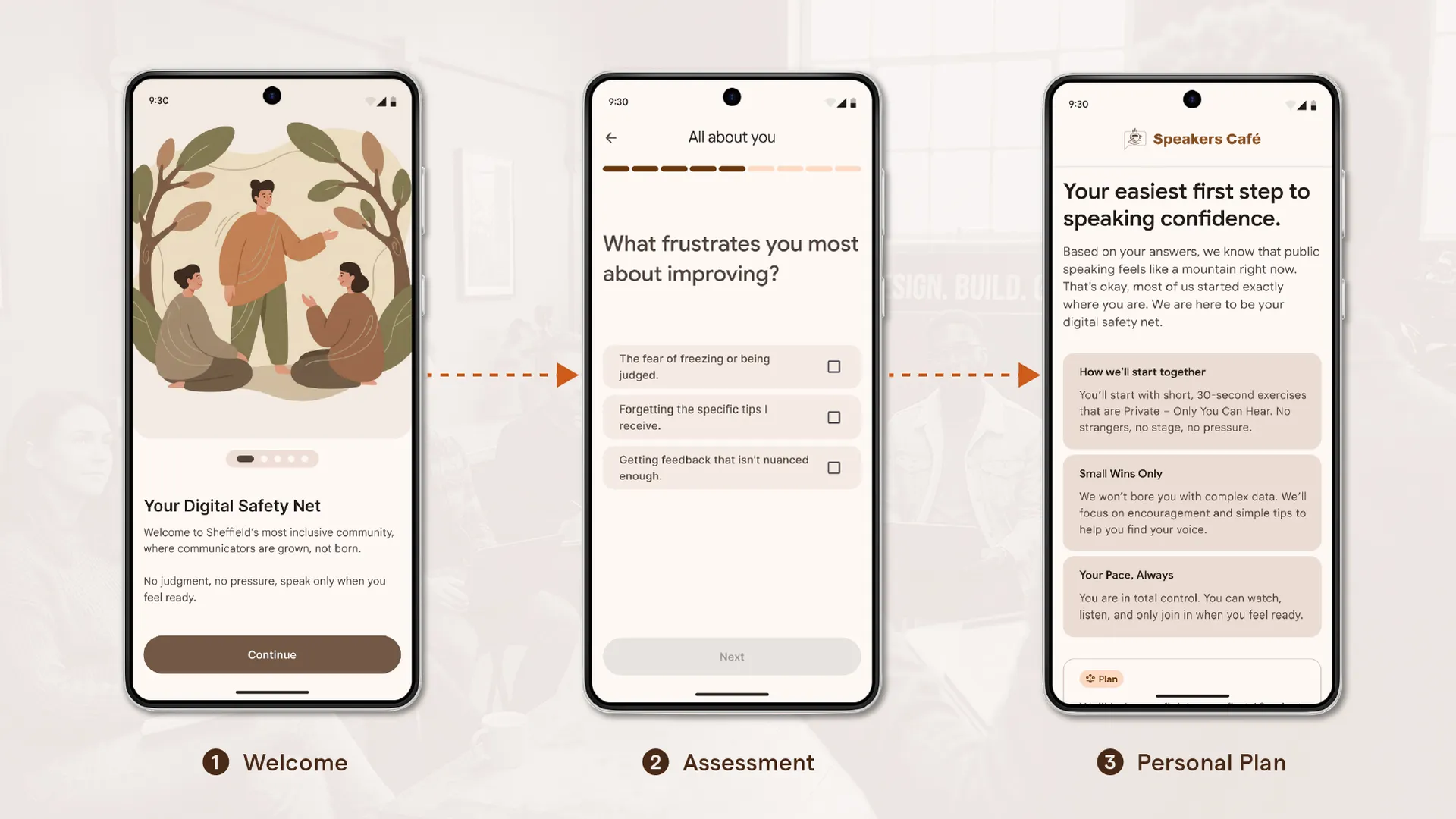
Diagnostic Personalisation Flow
The Private Space
The core of the application is a rehearsal environment designed to provide absolute privacy. I integrated persistent visual cues, such as the Shield Icon, to remind users that their recordings are encrypted and stored locally.
AI analysis provides immediate, private feedback on pace and clarity, allowing users to experiment and iterate without fear of external judgment.
This "Digital Safety Net" creates a low-stakes environment where users can build their foundation in total security.
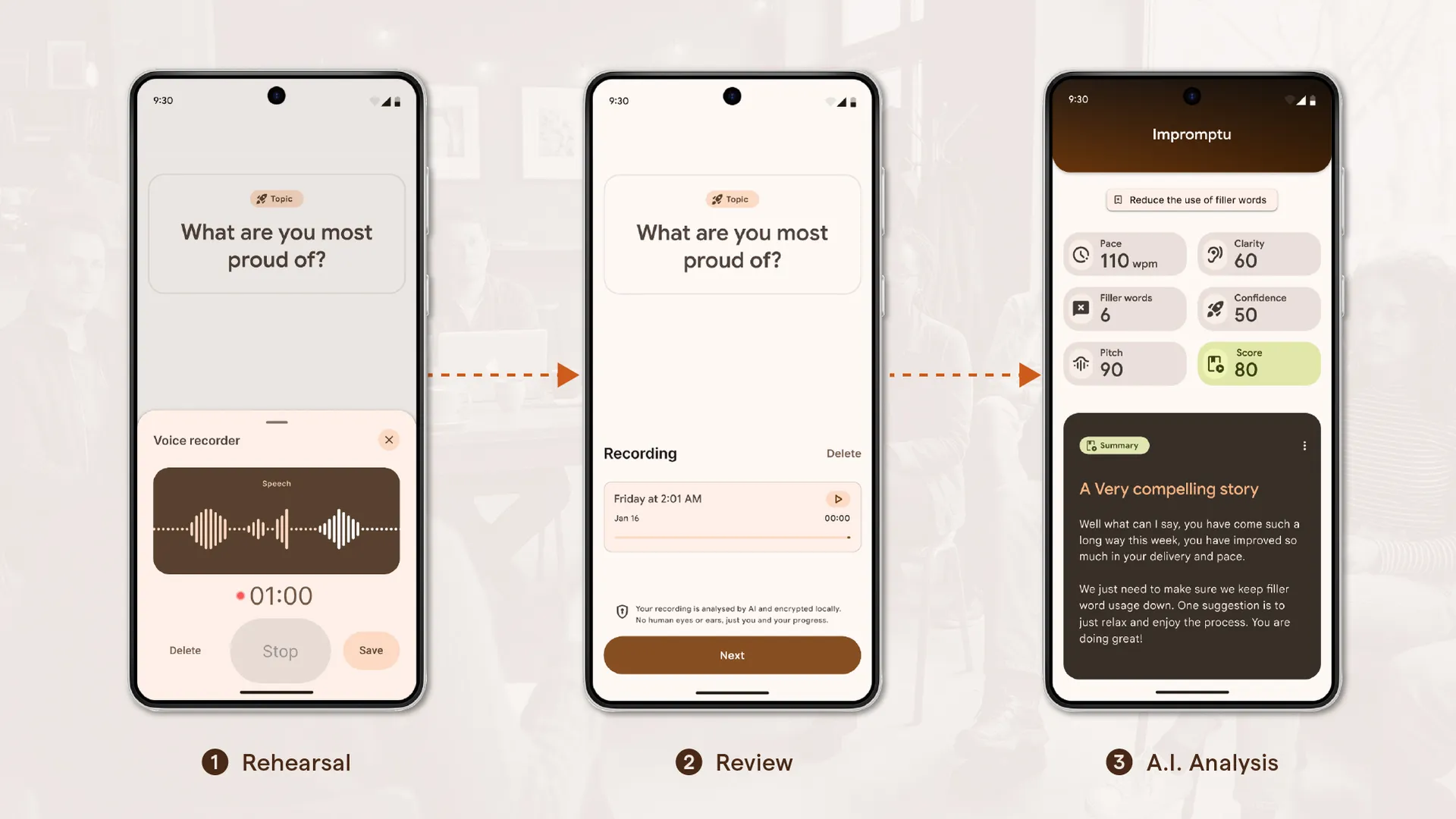
Secure Rehearsal Environment
Community Feedback
Once a user feels ready to share their progress, the Visibility Slider manages the transition into the community.
For example by choosing the "Trusted Peers" tier, users can receive nuanced, human feedback from experienced mentors in a controlled setting.
This reciprocal model moves beyond automated data, building collective confidence through mutual support. This interaction prepares users for the social dynamics they will encounter in the physical club sessions.
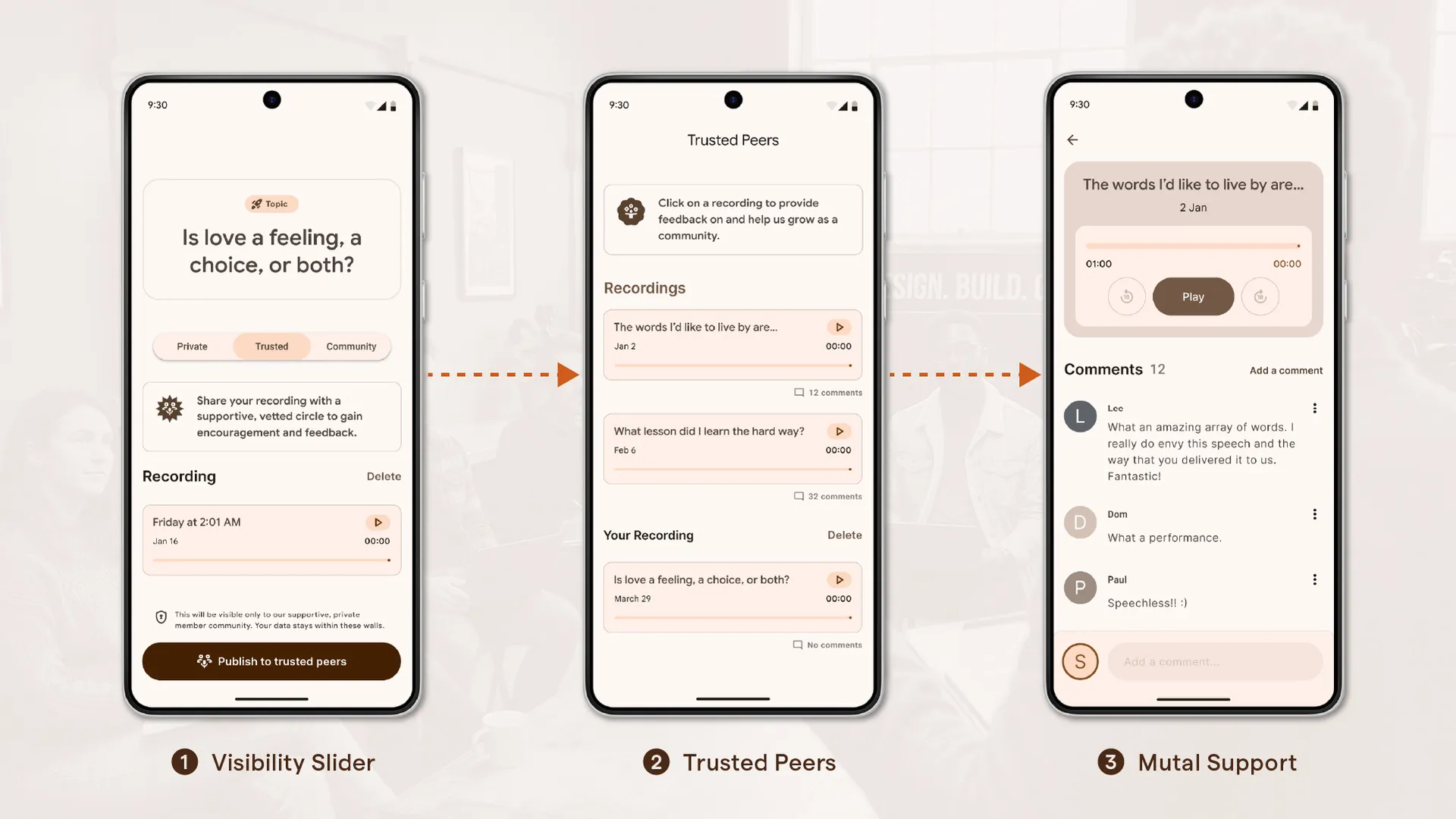
Vetted Peer Feedback Interface
Bridging the gap
The final stage of the journey facilitates the move to the physical "Speak Up" sessions in Sheffield. The app monitors user progress and provides a ’Readiness Signal’ when a user has reached a consistent level of engagement.
A streamlined booking interface is integrated directly into the app, providing a clear path to physical attendance. This ensures the digital tool acts as a supportive preparation phase for the club’s in-person coaching and community events.
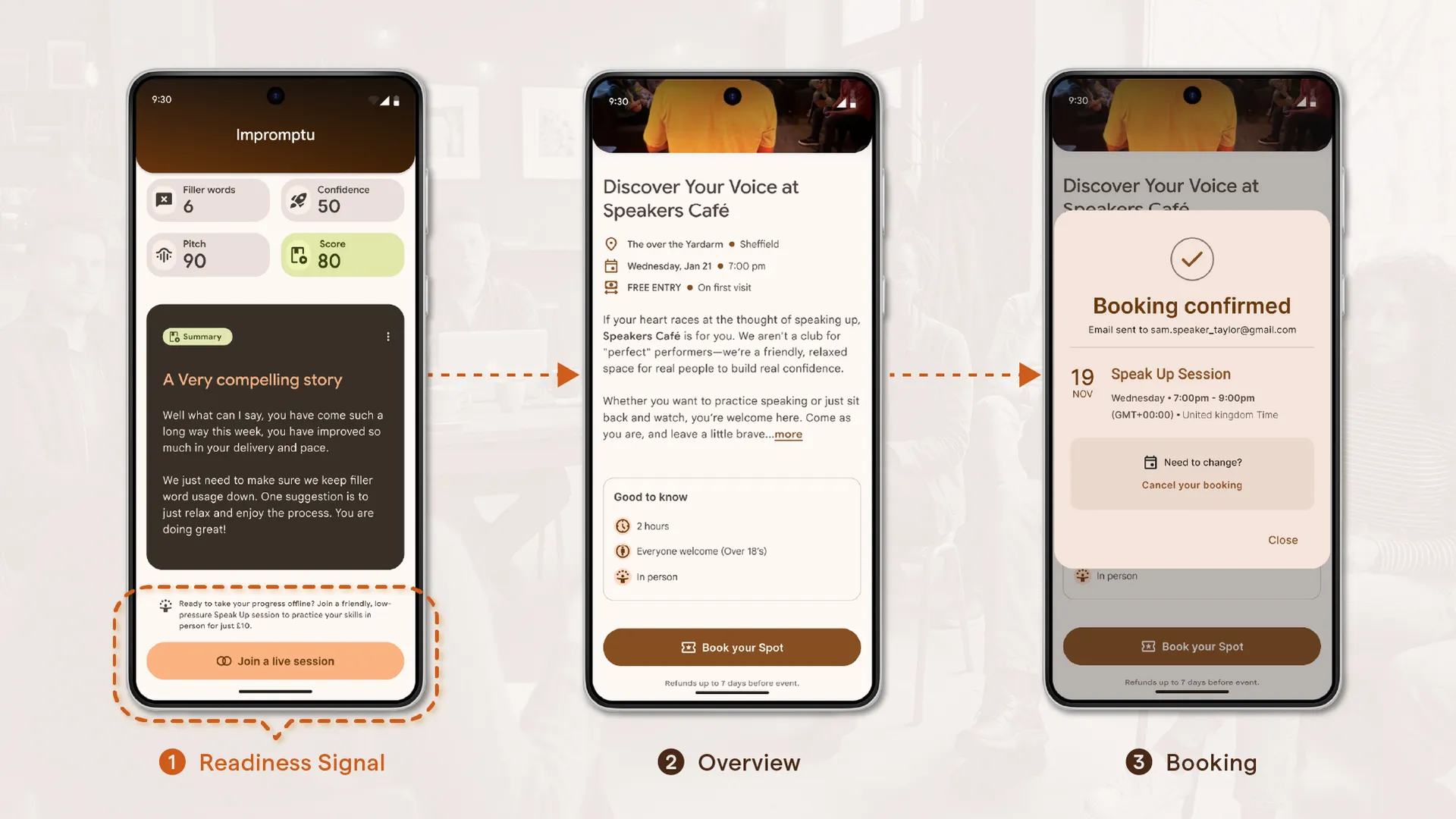
Transition and Booking System
Usability Scale
I conducted two phases of testing to ensure the interface was both functional and supportive.
The initial high-fidelity prototype achieved a System Usability Scale (SUS) score of 97.5, confirming that the core navigation and diagnostic tools were intuitive. Following this, I performed a qualitative review of the final design.
Participants reported a significant increase in emotional comfort, noting that the new gradual exposure model removed the hesitation they had previously experienced.
This validated that the design had moved beyond simple usability to provide a genuine sense of psychological safety.
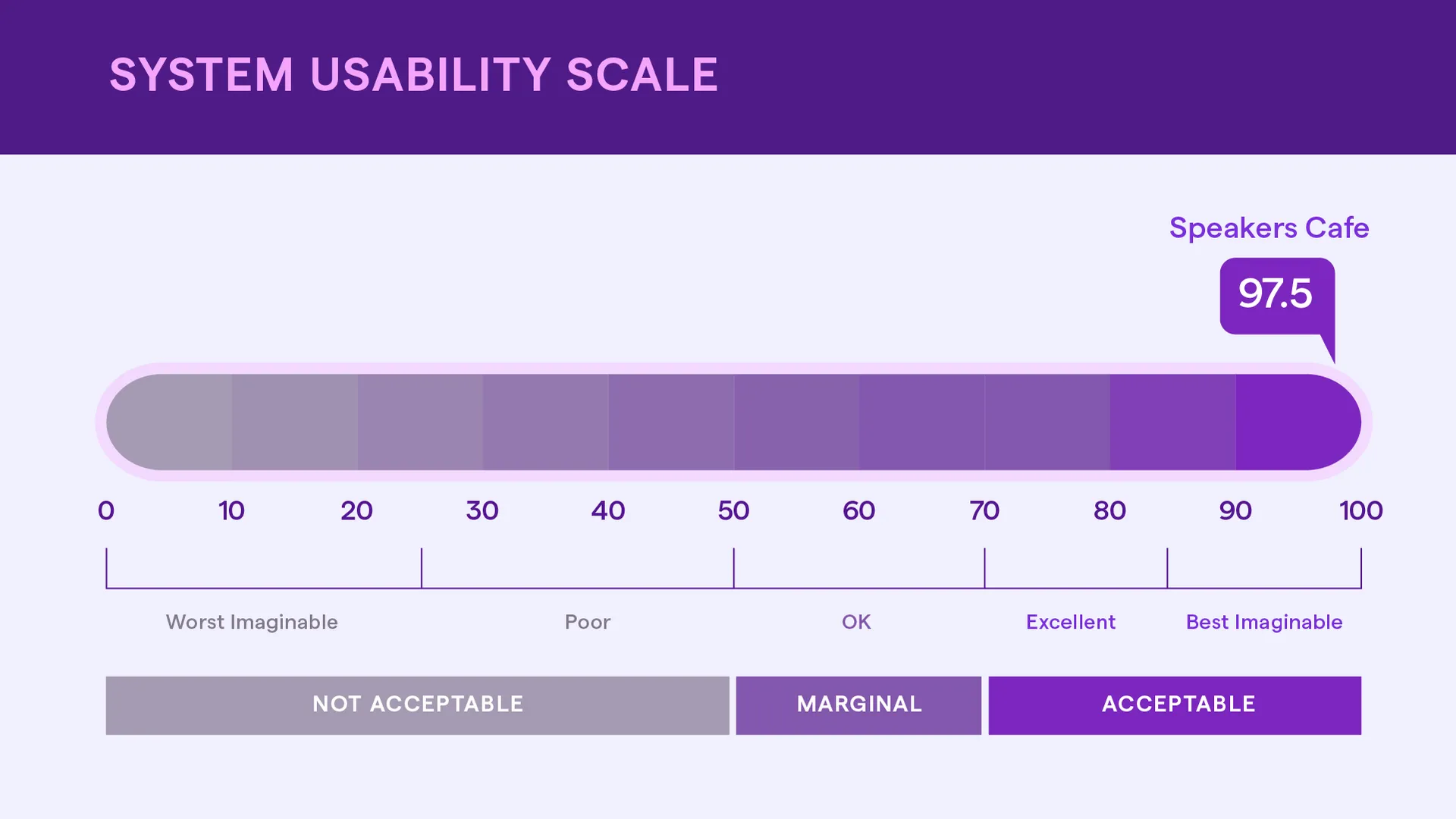
System Usability Scale (SUS) Results
Confidence growth
To evaluate the impact of the ‘digital safety net’, I tracked changes in user confidence during a single session. For the most hesitant users, confidence scores consistently moved from a 1/5 (High Hesitation) to a 3/5 (Managed Readiness).
While this represents incremental growth, it indicates a successful reduction in the social anxiety that previously blocked participation.
This state of ‘readiness’ is the critical threshold required for a user to move from a private digital space to a public physical environment.
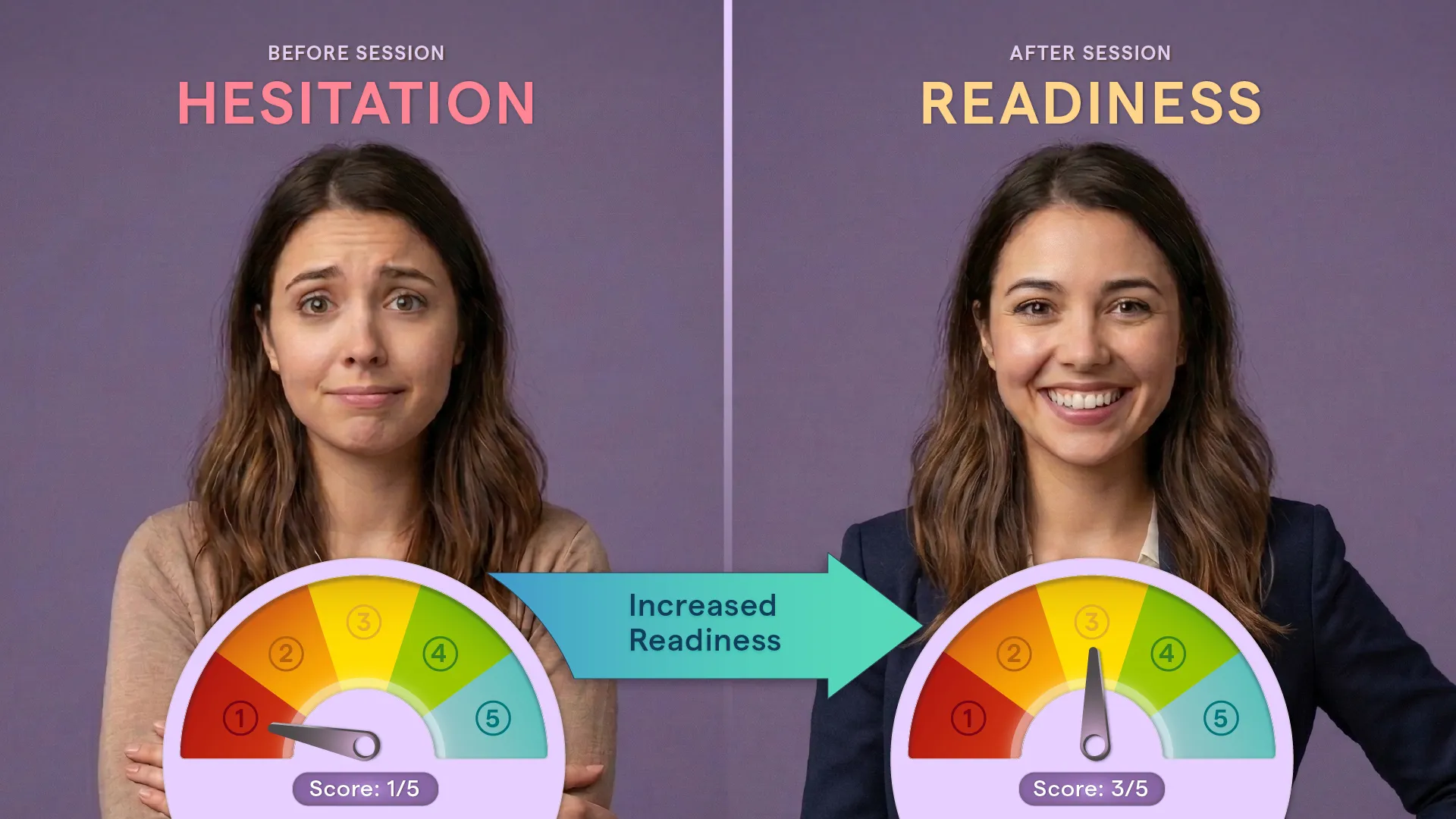
Persona Confidence Delta
Attendance readiness
The primary objective was to facilitate the transition from digital practice to physical participation at the Sheffield club.
During final validation, every participant confirmed they were now prepared to attend an in-person ‘Speak Up’ session.
This result indicates that the ‘digital safety net’ effectively addresses the initial hesitation associated with public speaking.
By preparing users for the social dynamics of a live environment, the app serves as a functional bridge between digital interest and physical club growth.
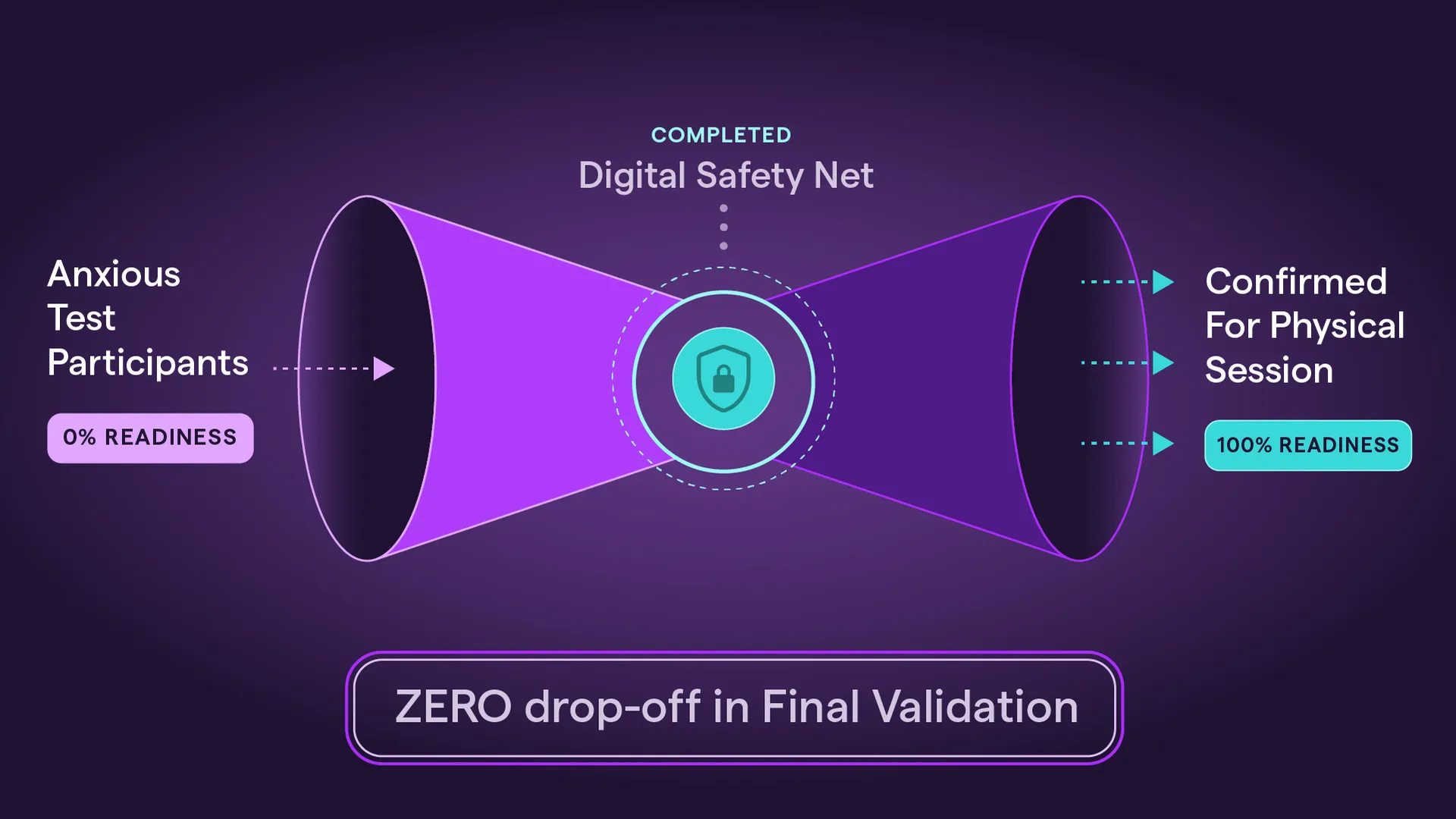
Conversion Readiness Data
Future considerations
The next phase of development will focus on refining the balance between automated tools and community-led mentorship.
- 1
I will optimise AI processing to ensure feedback is delivered immediately after recording. Minimising any chance of the rise in anxiety and self-criticism that often occurs during processing delays.
- 2
I will explore a path for private, direct feedback from the founder. This would provide a final layer of reassurance before a user transitions to the full community ‘visibility tier’.
- 3
I will monitor user attendance over six months to evaluate how digital practice impacts consistent participation in the physical club.
Design Discourse
Explore Bromel's projects.